Exclusive: A Brief History
And at the end of the day, bring in the local Mr. Big in the news media and give him an exclusive. Play your friends. It has an enormous effect.
Ever since I picked apart coverage on The Verge, I’ve had the urge to go out and try to understand the word “exclusive,” whose use set off red sirens in my head for reasons I couldn’t articulate at the time.
I tried to describe it thusly last month: “To me…exclusive in a headline means more than just images, but analysis and original writing you won’t find anywhere else.” That was an oversimplification and at least one reader took note.
I’ve done a bit more thinking on the matter (in addition to research) and have come to the conclusion that the meaning of “exclusive” has been perverted to the point that it is basically useless. Allow me to share some of what I have learned.
The “Adverse Faction”
The Oxford English Dictionary lists many definitions for “exclusive.” For our purposes, lets go with the adjective under A.II.6.a:
In which others have no share, esp. of journalistic news or other published matter.
The noun form under III.B.4 is perhaps more instructive:
An article, news-item, etc., contributed exclusively to, or published exclusively by, a particular newspaper or periodical.
But the OED’s real charm, of course, is its citations. The earliest use of a journalistic “exclusive” they list is in the first issues of Punch, a humorous British weekly started in the mid-nineteenth century. Surely, though, this use predates it as Henry Mayhew’s brash magazine spent much of its inaugural year lampooning its dubious use elsewhere in printed media. Take this story filed in the August 28, 1841 issue:
AWFUL ACCIDENT.
Our reporter has just forwarded an authentic statement, in which he vouches, with every appearance of truth, that “Lord Melbourne dined at home on Wednesday last.” The neighbourhood is in an agonising state of excitement.
FURTHER PARTICULARS.
(Particularly exclusive.)
Our readers will be horrified to learn the above is not the whole extent of this alarming event. From a private source of the highest possible credit, we are informed that his “Lordship also took tea.”
And on and on joking about an inconsequential “exclusive” until:
THIRD EXPRESS.
Hurrah! Glorious news! There is no truth in the above fearful rumour; it is false from beginning to end, and, doubtless, had its vile origin from some of the “adverse faction,” as it is clearly of such a nature as to convulse the country.
In the December 4, 1841 issue, Punch takes more direct aim at a rival’s reportage:
“STUPID AS A ‘POST.’”
The Morning Post has made another blunder. Lord Abinger, it seems, is too Conservative to resign. After all the editorial boasting about “exclusive information,” “official intelligence,” &c. it is very evident that the “Morning Twaddler” must not be looked upon as a direction post.
Haven’t I heard this sort of media bickering elsewhere, recently? Ah yes, Gawker’s A.J. Daulerio sounded the same alarm this past Friday:
Today we’ve installed an editorial policy at Gawker which I hope will stick for some time: It’s about the word “Exclusive” being used in headlines and tags. It should be avoided at all costs, barring strange, unique circumstances wherein we feel it’s necessary to inform dumb readers that the story they are reading on this site was generated here and only here despite our dubious reputation as content remoras.
[…] This policy is not being put in place to undermine the work done here in the past; it’s more to prevent this site’s current iteration from adding additional levels of obnoxious dick-twirling often perpetrated by some other online gossip sweatshops that stumble upon BIG JUICY SCOOPS on an hourly basis because dimwitted celebrity horror shows just happen that frequently. I mean, seriously, you guys, just fuck TMZ in the mouth until they spit blood.
The word “exclusive” is nearly as old as big media rivalries,1 but it has never carried any sort of gravitas that those who like to slap it in a headline seem to think it has. For big egos and bigger brands, it has long been a tool for editorial oneupmanship, but for readers it has always been valueless.
Plants, Scoops and Leaks
William Safire, who captured the Nixon quote at the top of this article in his book, Before the Fall: An Inside View of the Pre-Watergate White House, is perhaps best remembered for his weekly “On Language” column in The New York Times Magazine. He had a gift not only for the intricate and difficult work of lexicography, but for boiling hundreds, if not thousands of years of knowledge and usage down to a few enlightening sentences.
In Safire’s Political Dictionary, he lays out the following definition under the entry for “plant”:
In current political usage, a LEAK is usually deliberate (as in Daniel Ellsberg’s massive leak of the Pentagon Papers to the Times), sometimes inadvertent (as in Undersecretary of State Richard Armitage’s offhand mention to columnist Robert Novak of the CIA Valerie Plame Wilson’s recommendation to send her husband to Niger to check out a tip about the sale of uranium ore to Saddam Hussein). A plant is always deliberate, and connotes “control” of the reporter’s story; an exclusive has a more legitimate ring, although reporters left out are envious; a scoop is dated slang for what is now a beat, which carries the least stigma of deliberate origination by the source, and usually means the reporter dug out the information by his own enterprise.
An “exclusive,” then, is just another way of saying a story has been planted by whomever wants it to appear in whatever outlet seems most beneficial to them. It’s Gordon Gekko calling The Wall Street Journal and saying “Blue Horseshoe loves Anacott Steel.” Like I said of The Verge last month:
How does one outlet get two non-starter exclusives from the same company in one week? The only conclusion I can think of is that Amazon is leaking them stories they want out there.
The October 2012 cover of Vanity Fair is instructive:
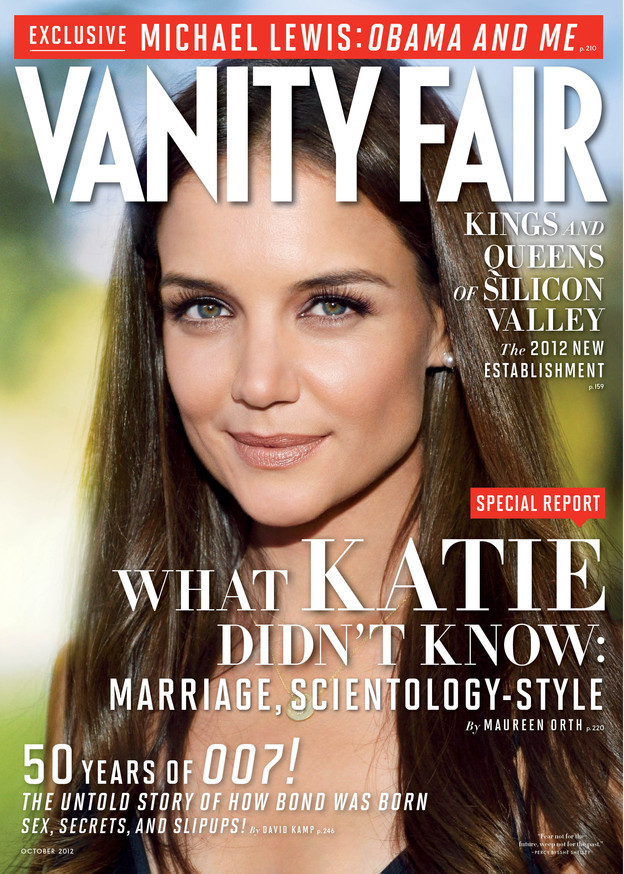
Vanity Fair October 2012
Michael Lewis was embedded with President Barack Obama for months, allowing him access to the man no other journalist could possibly achieve through regular means. It’s not just the resulting story that is exclusive, but the access granted to Lewis and all the strings that come with it, as reported by Jeremy W. Peters at The New York Times:
Like other journalists who write about Washington and presidential politics, Mr. Lewis said that he had to submit to the widespread but rarely disclosed practice of quote approval.
During a discussion at Lincoln Center on Monday night with Graydon Carter, the editor of Vanity Fair, Mr. Lewis volunteered to the audience that as a condition of cooperating with his story, the White House insisted on signing off on the quotes that would appear.
It doesn’t really matter where you come down on the validity of Lewis’s story; it is now a known fact that his source approved what appeared in print. This is what an “exclusive” looks like. A journalist and outlet was picked from among the many to reveal an otherwise unseen side of Obama. The “control,” as Safire would put it, was always in the hands of the source, not the journalist. Readers can be as discomfited as they like, these were the terms of what was clearly a mutually beneficial story.
Now let’s look at the other big story on VF’s cover. Listed as a “Special Report,” Maureen Orth’s article, “What Katie Didn’t Know: Marriage, Scientology-Style,” digs deep to reveal the lengths that Tom Cruise’s handlers went to find him a mate that wouldn’t embarrass the Church of Scientology.
Though private time with the President weeks before an election may be the weightier piece, Orth’s revelations required what most would consider grittier journalism. As Safire would put it, she dug out the information of her own enterprise. And yet her story, which no other outlet unearthed, doesn’t have “exclusive” in the headline. That’s because it would be in poor taste to gloat about what it really is: a “scoop.”
There is No Exclusive
This entire exercise, for me, has been to understand when and how to apply the word “exclusive” in my own work. After all, I’ve broken news here at the candler blog and at other outlets. I’ve never felt the need to write a headline with “exclusive” in it, even when the information I’m reporting is, in fact, unable to be found anywhere else. Am I doing it wrong, though?
At best, an exclusive is the result of a uniquely symbiotic relationship between source and journalist, with one extending a hand to the other for any number of reasons. It could be that the source wants to reach the widest possible audience, or a specific one, as in the case of Gordon Gekko and his man at The Journal. It doesn’t have to be all that nefarious, as in the case of Michael Lewis at Vanity Fair, whose access still told a compelling tale readers the world over are otherwise blind to, though one does have to wonder about what didn’t make the cut.2
At worst, the world of the exclusive is a dirty one in which media moguls use their brands and their checkbooks to battle it out publicly. In the entertainment world, a world I generally consider my beat, this plays itself out ludicrously on a daily basis, with outlets constantly reporting the same news as exclusives. No paper, tabloid or Web site seems ready to sit down and agree to terms for détente. And so the war trudges on, as outlets duke it out for readers and pageviews.
The truth, buried too deep for the average reader to care, is that “exclusive” is a holdover, a relic; the ink-stained wretches seem unwilling to let it fall to the wayside and their protégés and admirers seem fixated on letting the idiotic term find a home in our digital future. “Exclusive” is a way to dupe readers into taking you seriously, into believing that yours is the only page upon which they can devour the freshest and the latest. But that’s a lie. It always has been.
There is no great history to “exclusive” journalism. Ultimately, there is no exclusive journalism. It’s a term that was made up by publishers to nab an audience and further pirated by sources to communicate how best to spin the media in whichever direction they please.
So stop using it. All of you. Readers deserve better and this medium demands we provide it. Eventually they will flock elsewhere, where the stories are more substantive than the headlines.
Note: Some of the links in this story point to Amazon.com. These are affiliate links, and using them to shop for goods will support this site and the independent writing that appears here. I thank you in advance.
-
Which I would approximate starting in the early eighteenth century when Benjamin Franklin strong-armed his way into the publisher’s seat at The Pennsylvania Gazette, as described in Walter Isaacson’s excellent biography. ↩︎
-
Lewis claims only about 5% of what he witnessed couldn’t be published. Of course, that 5% could well be a bombshell; we’ll never know. In defense of this arrangement, Lewis may well have witnessed matters of national security what would endanger Americans abroad; the White House may have simply been trying to prevent such a slip, not cover up a scandal or obscure a conspiracy. ↩︎
They Don't Call it “iEconomy” for Nothing ⇒
Charles Duhigg and Steve Lohr, continuing the great 2012 New York Times tradition of framing a criticism of the technology industry as a judgement against Apple:
The evolution of Apple into one of the industry’s patent warriors gained momentum, like many things within the company, with a terse order from its chief executive, Steven P. Jobs.
And a yarn is then spun in which a cabal of Cupertino inventors/samurai train themselves, behind closed doors, to wield the mighty patent and use it for the forces of evil.
Oh, and there’s this (compressed to expunge some backstory):
In March 2010, Apple sued HTC, a Taiwanese smartphone manufacturer that had partnered with Google. […]
It was one of seven major smartphone and patent-related lawsuits Apple has initiated since 2006. […]
Over the same period, Apple itself has been sued 135 times, mostly by patent trolls interested in its deep pockets.
You know, patent trolls. Forget about them, though, because Apple are the real patent assholes stifling innovation.
They have to be, otherwise the whole “iEconomy” moniker doesn’t make any sense. There has been a lot of great reporting this year under that title, but sometimes it feels as though The Times reportes put in extra elbow-grease to be critical of Apple first, critical of the industry second. How can trolls be brushed under the carpet in an article examining how shitty the patent system has become?
Screen Time 8: The Problem with Roku ⇒
My pal Moisés Chiullan welcomed me onto the latest episode of his podcast, Screen Time, over on the 5by5 network.
The good stuff (i.e. me talking) starts around 14:55 when Moisés says we’re two peas in a pod. We talk about the new Roku bundled projector from 3M, Frankenweenie and Doctor Who, among other little tid-bits that should pique your interest. Check it out.
“3M Streaming Projector Powered by Roku” is the Actual Name of a New Product ⇒
3M and Roku just announced a partnership, shipping a mini-projector with an integrated Roku Streaming Stick:
The projector is small enough to be carried around, bright enough to project a picture 120-inch picture, and powerful enough to pack over two and a half hours of battery life–“long enough to watch just about any movie,” according to Mark Colin, 3M general manager of mobile interactive solutions.
This thing sounds even dumber than the streaming stick itself, which will only work with televisions whose HDMI ports are Mobile High Definition Link (MHL) compatible. This allows the HDMI port to feed power to the $99 (!) stick.
I don’t get the thinking here. It’s more than likely that you won’t be able to plug the streaming stick into anything other than 3M’s projector, so there’s no real value-add. The Fast Company article by Jillian Goodman linked above also drops this bit:
As far as Roku goes, they’re aiming at nothing short of being the OS of TV. “I guess I would say Roku is sort of where I thought the world had been heading for a while,” says [CEO Anthony] Wood. “It’s just taken a while to get here.”
Why not partner with actual television makers? Better, why not start by building Roku as an OS on the 3M projector?
Anyway, I still love my Roku LT. They offer the most comprehensive web-TV offering out there and I want to see them succeed. This stick just sounds like a year or more of wasted effort.
If you want to order a 3M Streaming Projector Powered by Roku, please use this link so I’ll get a few bucks. You’ll be supporting this site and independent writing.
#hypocrisy ⇒
TweetDeck, which is owned by Twitter, gives you the option of seeing updates from your Facebook friends in the same timeline as tweets from people you follow. While that’s a useful tool for many people, it appears the measure is breaking rules on displaying tweets, which came into effect Friday.
I know, I can’t believe the hypocrisy at Twitter either.
A Case of the Stupids at the New York Times ⇒
James B. Stewart, [shooting from the hip in The New York Times][nyt]:
Apple’s use of its own mapping technology in the iPhone appears to be a textbook case of what’s known as a tying arrangement, sometimes referred to as “bundling.” In a tying arrangement, the purchase of one good or service (in this case the iPhone) is conditioned on the purchase or use of a second (Apple maps).
To the degree that tying arrangements extend the control of a dominant producer, they may violate antitrust laws.
Bullshit.
Apple is making it abundantly clear, almost embarrassingly so, that they offer many competing map platforms on iOS. Yet because Google1 Maps isn’t available on iOS somehow Apple is breaking antitrust laws on the scale that Microsoft did with Internet Explorer?
Mail some of whatever they smoke in midtown down Austin way, wouldya?
-
Who, mind you, actually took the exact opposite approach and built an OS to house their mapping data. Talk about antitrust… ↩︎
GitHub:Training ⇒
GitHub:Training is a brand new site from the social coding network:
No matter where you are in the world, we have a mix of both live classes and recorded tutorials that you can access from the comfort of your own computer.
Very neat idea with a handful of free classes I may just audit.
Of course, “git - the simple guide” should spin you up pretty quickly, but knowing Git is only the beginning. Having just dipped my toes into hosting code at GitHub, there is definitely a learning curve to the way the site uses version control, with a slew of power tools waiting to be unleashed.
Pumpkin Spice Latte Shortage ⇒
Lisa Fleisher for The Wall Street Journal:
“My world almost ended this morning when the local Starbucks told me they were out of Pumpkin Spice Latte,” tweeted Jason Sizemore, 38 years old, of Lexington, Ky.
Cynthia Smalls, a barista at a midtown Manhattan Starbucks, said steamed customers have grown emotional on days her location runs out of pumpkin sauce. “They go crazy. The day we first found out we had a shortage, forget it,” she said.
Her own surprised reaction: “You guys do know it’s just a drink, right?” she said.
Thanks a lot, Obama.
(via Daily Intel.)
Read This → 2030: The Real Story of What Happens to America
I picked up 2030: The Real Story of What Happens to America1 a short while back on the recommendation of my pal, Rafi. I’ve always loved Albert Brooks and was curious what a novel by the comedian and auteur would be like. Plus it had the added bonus of being cheekily billed as a near-future tale of what would happen if America elected a Jewish President. Hilarious!
While it is a work of comedy, Brooks also makes a lot of astute observations about our nation and the geo-political climate we live in. In the run-up to the Presidential election, I highly recommend you give it a look.
When I wrote yesterday about Mitt Romney’s PBS comment, I refrained from commenting on his context: “I’m not going to keep on spending money on things to borrow money from China to pay for it.” 2030 deals largely with an America that becomes dependent on Chinese funds. While initially I thought of the book as a sort of conservative cautionary tale, Rafi turned me on to the idea that Brooks is offering instead a positive outlook on a globalist future. China’s ascent, in other words, doesn’t have to be America’s undoing.
There is a patina of old-world racism to Romney’s riffs against taking Chinese money. He could have set forth a plan to avoid taking foreign money altogether, but refusing British or German funds doesn’t light a fire under Americans’ asses. When he talks about China he’s invoking images of some kind of unsavory back room handling, loan sharking being peddled alongside opium pipes and gremlins. Now, there may well be reasons not to grow our debt, but racial myopia isn’t one of them.
2030 paints a starkly realistic, if exaggerated, picture of America’s trajectory, laying bare the classist, ageist and racist rhetoric that has come to define our politics. It does so with plenty of laughs and without taking a partisan stance. One of the main lessons I learned is that cooperation between China and the US should be far from our worst fear. I don’t want to wait 18 years as a nation to come to that simple realization.
-
Affiliate link. Thank you. ↩︎
The Crazy One ⇒
I wrote this last year after Steve Jobs’s departure from Apple:
I got my first Mac in 2002, and no other tool has enhanced my ability to express myself better. Steve: thank you.
Still true.
Apple has a nice tribute up on their home page today, the one year anniversary of his passing.