Interview With the Digital Bolex Duo ⇒
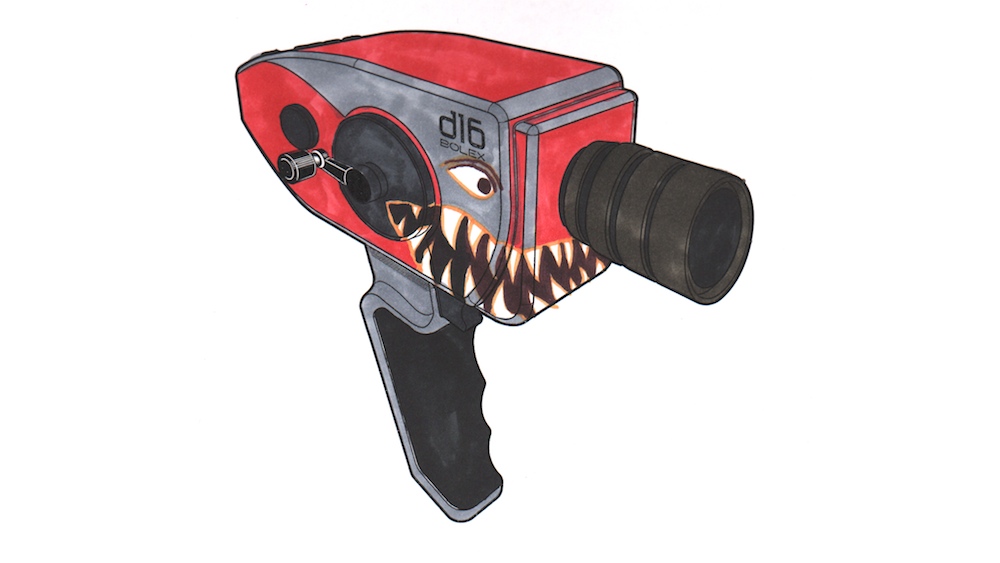
The Digital Bolex
I interviewed Joe Rubinstein and Elle Schneider, makers of the forthcoming Digital Bolex, for The Creators Project. I love the way this project is coming together and that we’re at a point, thanks to crowd-funding platforms like Kickstarter and the modularity of technology, that two film nerds could think up a camera and actually get it built.
Plus, Elle owns up to the camera’s unique style:
If you want to blame someone for retro-fying the camera a bit, a lot of that blame falls on me. I originally got the idea for fancifying our pistol grip from seeing this Bolex called the Macrozoom that everybody loathes. And the crank idea was also stolen from that Bolex.
I really can’t wait to see one of these in the wild.
Tips for Holding the Slate Properly ⇒
Evan Luzi over at The Black and Blue on operating a clapboard:
Holding the slate seems like an obvious act — and it largely is — but you should take these five tips into consideration before stepping in front of the camera.
I’ve often wanted to reach through a monitor and shout these tips at the camera crew. Great list.
Where the RobTrew OmniFocus Scripts Are ⇒
If you’ve ever dipped your toes into hacking OmniFocus (or spent even a moment on Omni’s excellent forums) then you’ve heard of RobTrew. His scripts are essential, doubly so if you ever find yourself suddenly becoming an edgecase. When MobileMe closed down on June 30th, with it went his scripts.
Of course, Rob was on top of it. You can find all of his scripts here, though his original Omni Group forum post implies they may be moving eventually. Get ’em while they’re hot.
And thanks, RobTrew. These are awesome.
Amazon’s Abysmal Update
Unless I have to, I don’t buy paper books anymore. I don’t read a lot of books (Instapaper has handily overtaken my attention) but when I do I prefer to buy them from Amazon. Well, I did until recently.
Far and away Amazon offers the most compelling electronic reading experience. Almost anywhere I can access the Internet, I can read a Kindle book. That’s huge. There’s only one problem. As pointed out by Bryan Larrick over at Daily Exhaust1 last week, Amazon recently updated the Kindle for iOS app with the following adjustment:
Improved reading experience on iPad: Smaller margins and a cleaner look help you focus on the author’s words.
Larrick goes into detail, with great illustrations, about why this update makes reading worse, but here’s the short of his take on those new margins:
What Amazon has done is create a solid mass of text that has no breathing room. It’s claustrophobic. It’s stressed. It’s like standing three feet in front of a brick wall and pretending you’re appreciating the architecture of a building.
When it comes to issues of design and typography, I try to make sure I’m not overthinking things, that I’m not just being a princess nagged by a pea. Still, I’ve given the new Kindle app a little over a week of daily use and it is absolutely abysmal. My eyes get tired more quickly and I have to look away from the screen more often. In turn it takes me longer to get through a book. And that annoys me.
Over time, iBooks has grown into my favorite reading app. The font choices are excellent and the fullscreen view fixes the app’s formerly skeuomorphic/fetishistic paper feel. Apple even gives you option to align your text left, or “ragged right” in printspeak, and toggle hyphenation on and off, which helps avoid the massive “rivers” of whitespace running down the page that plague the newest Kindle app. Even the page and notes sync between iBooks on iPad and iPhone, powered by iCloud, is far more intuitive than Amazon’s “Whispersync”2 system. So shouldn’t I just switch to iBooks?
The trouble is that I’ve been spoiled by Amazon’s ecosystem. I love that I can get a few pages in on a Mac or in a Web browser.3 If ever I need to quote a book or go back to notes, their kindle.amazon.com is a total treat.
But for now, I loathe reading with these new margins on my iPad. And that makes me never want to buy a Kindle book again.
-
Via John Gruber. ↩︎
-
What’s the holdup, Apple? Just release iBooks for Mac and be done with it. ↩︎
Sparrow Mail Tips ⇒
I switched to Sparrow on my Mac and iOS for email earlier this year and I absolutely love it. The gang at Sparrow now maintains two Tumblrs listing tips about both the Mac and iOS versions of the app: Sparrowtips and Sparrow iPhone Tips.
Sparrow is an extremely powerful mail application on any platform, but the tips listed on these sites are little nuances that took me weeks and months to discover. Glad to see they’ll be easy to find and visualize on day one.
Bilton's Folly
Nick Bilton over at The New York Times (who I criticized way before it was cool) was on the receiving end of some harsh words this week after his June 19th blog post, “Microsoft Surface Allows People to Create.”
The iPad, for all its glory, suffers from one very distinct flaw: It’s very difficult to use for creation. The keyboard on the screen, although pretty to look at, is abysmal for typing anything over 140 characters.
Apple bloggers, naturally, took Bilton to task. After all, his Apple slags came in the reflected praise he was heaping on Microsoft’s just-announced Surface tablet. At best, Bilton’s piece was a crock. Take his closing line:
Yet many budget-conscious consumers who pass on the iPad and go for a computer instead may now have a choice to buy a device that doubles as both.
Microsoft has kept mum on Surface’s pricing, so either he’s got a real source (in which case he should commit some journalism and report on it) or he’s just making shit up. I’ll put my money on the latter.
Yesterday he responded to the criticism in another post, “When Zealots Attack.”1 Here’s Nick’s defense of his iPad-isn’t-for-creation stance:
I absolutely love typing on my iPhone, where I can pummel my thumbs at the screen with the speed of Superman and the accuracy of an Olympic archer. But, for me, typing long form on the iPad is much more difficult. Maybe it’s a simple problem of the keyboard design on the iPad.
Others have pointed out in great detail how many people have used the iPad for creating artwork, music, books and so forth. But Nick doesn’t use his iPad for any of that, so it isn’t a creation device for him.
Which is all well and good, only that’s not what he said in his original post. Where does Bilton let us know that he is offering a personal opinion when he says things like “The keyboard…is abysmal” and “Apple doesn’t seem to want the iPad to be a creator”? He can’t have it both ways, wrapping opinions up as facts on a Tuesday and then explaining what he meant on a Friday.
So Bilton is trying on the “Apple Fanboys are mean” defense. Hell, he even tried an anti-corporate approach…to back up a piece he wrote about a Microsoft product:
But guys, these are products. They are products we buy, with our own money, from Apple — a company that makes a very hefty profit from those transactions.
He doesn’t get it. What he did this week was chip away not only at his own credibility but also at that of the publication he writes for. This wasn’t journalism, it was a cheap attempt at link-bait (which worked, twice), the kind of bullshit we’ve gotten used to over at Business Insider and The Huffington Post.
So Nick, I don’t think you’re an idiot, but you sure acted like one this week. Now do you have anything original to write for America’s paper of record, or are you just going to clack out the first idea that comes to you? That is, if there’s a Surface nearby.
-
According to Jim Dalrymple over at The Loop, who offered the most boisterous criticism of Bilton this week, the headline originally read “When Apple Fanboys Attack.” ↩︎
I Interviewed Todd Solondz ⇒
I interviewed Todd Solondz for Heeb. On working with Christopher Walken in his new film, Dark Horse:
Chris [Walken], he, I think was eager, as I was told, to play a human being. He is cast in so many larger than life sorts of characters. He wanted to play something that was more grounded. And so he embraced the toupée and the change in his eyes and muting him, turning him into a sort of regular kind of guy. I mean his face is powerful and iconic as it is so I was all about restraining that.
Go read the whole thing, please.
Letter to Emily White ⇒
This weekend Emily White, a twenty year-old intern at NPR’s All Songs Considered, wrote a blog post defending her music library, which contains over 11,000 songs she mostly hasn’t paid for.
On Tuesday, David Lowery published a devastating, 4000 word response to her post over at The Trichordist.
I also find this all this sort of sad. Many in your generation are willing to pay a little extra to buy “fair trade” coffee that insures the workers that harvested the coffee were paid fairly. Many in your generation will pay a little more to buy clothing and shoes from manufacturers that certify they don’t use sweatshops. Many in your generation pressured Apple to examine working conditions at Foxconn in China. Your generation is largely responsible for the recent cultural changes that has given more equality to same sex couples. On nearly every count your generation is much more ethical and fair than my generation. Except for one thing. Artist rights.
Piracy is the third rail on blogs, but Lowery injects the conversation with a healthy dose of humanity, an element usually lacking from these sorts of diatribes.
Read the whole thing. It’ll make you want to buy an album or five.
How Apple’s Eyes Free Feature Will Work ⇒
Austin Lindberg reporting for Car and Driver:
It’s important to first point out that Siri is a software change, both for the car and the phone, and not one that affects hardware—existing voice-command buttons will be used to access the system through a Bluetooth connection. According to an engineer we spoke to, Apple’s software development includes a refinement in how Siri deals with high amounts of background noise—the in-car’s single mic can pick up road, wind, and engine noise that makes it difficult for Siri to comprehend commands.
I love the idea of a Siri-enabled car. Apple and app developers are much nimbler than car manufacturers. If all the carmakers have to do is change the way their bluetooth button actuates, it could open up the in-car software landscape completely.
The same article has Chevy and Mercedes boasting they can add the integration by year’s end if not early 2013. Their sources seem excited to get this working.
Readability's Unclaimed Monies ⇒
Today, we’re announcing the end of one of those: As of June 30, 2012, Readability will no longer accept reader fees. [...] What if we’re not able to get every dollar back into every deserving writer’s hands? We’re going to do the next best thing we can think of. All remaining money that was put aside to be claimed by domain owners will be given to non-profit organizations that speak to the spirit of supporting reading and writing.
Readability is now a free service, and they’re trying to figure out what to do with $150,000 of unclaimed funds earmarked for publishers. The comments on Richard’s post quickly turned into a riot. People want their money back, people feel duped, people feel the whole charity thing is noble yet sleazy, etc.
I interviewed Ziade back when Readability’s iOS app debuted and again with the release of Readlists. While many people may be relieved the pay service is over, since it clearly became a second-class citizen once the service became free earlier this year, this backlash is sure to persist at least for a few weeks. But then what?