Drafts for iPhone: My New Scribbling Notebook
I heard about Drafts, Agile Tortoise’s iPhone notes app, when it initially launched. I’ve been a fan of the company’s apps for some time. I am still blown away by Terminology’s deep integration with Instapaper, and Phraseology has turned out to be my go-to iPad text app for editing long for pieces. So it was only a matter of time before I got on this train…
Drafts is an app with a very simple premise: write stuff. The interface is extremely spare by design. Launch the app and you are brought immediately to a new, blank note with the keyboard ready for typing. The 1.1 update Agile Tortoise pushed out this week allows you to send your text to a slew of other apps, including OmniFocus, Tweetbot, Sparrow and any app that recognizes plain text via iOS’s stock “Open in…” function. On top of that (and this is what sold me) you can even send your text to Dropbox (more on this in a moment).
I refrained from purchasing Drafts until this week because I didn’t see where it fit into my life. Since the initial version had no form of document sync I thought it would just add clutter and cruft to my workflow. As it turns out, my workflow already was cluttered; Drafts actually alleviated some of that mess.
Here’s a word on Dropbox integration from the Drafts 1.1 release notes:
“Save to Dropbox” action. Note this is not sync, but an export feature. Once you link your Dropbox account, selecting this action exports a timestamped text file to the /Apps/Drafts folder in your Dropbox.
Sync, by its very nature, adds a layer of complexity to any app. When do my documents sync? Where do they go? What happens if the sync gets interrupted? Even at its best, sync can get sloppy fast. Apps that sync over Dropbox seem to interact with it differently. For example, if I’m working on a document in Byword on my Mac and save it to Dropbox, if I leave the Mac app open and then go edit the document elsewhere, say on my iPhone (or even in another app on my Mac), it will cause a conflict. So I have to remember to close all instances of the app, something I learned the hard way. By forgoing sync altogether, that complexity melts away in Drafts.
For years now I have considered true sync an absolute minimum for any plain text editing app that I use. Drafts’ implementation, however, forced me to reconsider why I thought sync was so vital. For the most part, I sync files that I either am currently or soon will be editing. It hadn’t occurred to me that I could, or even should, write something on an iOS device that wouldn’t eventually be finessed into a final piece, that I could just write.
Back before the days of polished iOS writing apps, I always rode the subway with a notebook and a pen, often scrawling whatever came to mind. I rarely even turned that writing into anything later, it was just my way of working through some ideas. While I still keep a Field Notes memo book with me most of the time, I rarely turn to it anymore; all of my mobile writing happens on iOS.
The victim of this change has been my aimless scribblings. Nearly every app I use on iOS utilizes the same basic “document” model. Whatever I write usually needs a name and/or tags so that it can be differentiated from the other documents. As such, I couldn’t open an app and start writing Without feeling like I was working on something. That isn’t the only kind of reading I should be limiting myself to.
Drafts fills this crucial, creative void for me. I have no compunction about launching it and typing, well, anything. What I see, what I feel, what I’m thinking about for a potential future project, anything at all. I didn’t even realize I hadn’t been writing like this anymore, but I’m glad I now have a simple, fast solution for doing so. For 99¢, how could I not have bought it sooner?
Introducing Watch This, A New Weekly Column ⇒
The team over at Turnstyle just launched a new weekly column over at Turnstyle (where I also wrote a bit of coverage from SXSW) featuring the writing of yours truly called “Watch This.” Every week I’m going to feature and critique a film I find on the Web. From the first post, which went up a few hours ago:
Art, of any discipline, can only be as strong as its criticism. Critics are usually remembered for their harshest writings, but it is often the most critical writings that contribute to the unending conversation about cinema. Is it even possible to think about the rise of New Hollywood without the writings of Pauline Kael and Andrew Sarris? Critics can boost the profile of unknown work, enhance the global discussion of cinema and in some cases challenge filmmakers to make more complex films.
With that in mind, I have found that Web video, on the whole, is lacking in serious widespread criticism. Yes, online filmmakers have their champions, but there is such a glut of content uploaded every day that the critical community can barely keep up. Dated as it may be, the weekly theatrical release paradigm has allowed criticism to flourish alongside it. My goal is to sift through Web videos and, once a week, share with you a film that catches my eye and deserves some close inspection. Hopefully, this space will be a weekly snapshot of what is happening in the online film community.
I’m excited to see how this project goes.
Where Tech, Celebrities and Washington Meet ⇒
Excellent reporting by David Carr from the New York Times on the significance of the White House Correspondents’ Dinner. He paints a picture of the technology industry throwing its weight around in Washington as the “new” celebrities on the hill.
Carr opens the piece with an anecdote about Judd Apatow meeting Eric Schmidt, Google’s executive chairman and former CEO:
“Wow, I had to do a double take when I heard his name,” Mr. Apatow said, adding later that the company is “so central to my life. It threw me. It was like suddenly being introduced to the person who invented fire.”
The nerd in me is wondering if Apatow is just talking about Gmail (the obvious entry point), or if most of his work is stored and shared in Google Docs. Regardless, what better advertising for Google’s services than proof that the rich, creative and powerful rely on them? More important: what better proof that, whether they like it or not, the technology and entertainment industries are intertwined?
How Books Will Survive Amazon ⇒
Joel Epstein published this excellent piece at the New York Review of Books yesterday. He manages to break down some of the more dubious dark corners of the Department of Justices suit against Apple and the major publishing houses without getting too deep into the weeds of legalese.
Here he describes what books will look like in the near future:
Independent editorial start-ups posting their books on appropriate web sites have already begun to emerge and more will follow. The cost of entry will be slight. The essential capital will be editorial talent and energy, as it had been in the glory days before conglomeration when editors were themselves de facto publishers, publicists, and marketers. Many start-ups will fail. Some will not. Specificity, reflecting the structure of the web, will matter: a guide to the cultivation of daffodils will more likely succeed than a more diffuse gardening title.
The digital revolution is having the same effect on movies. Keywords: talent and energy. That’s a future that doesn’t look to bleak to me.
Try Getting 24 FPS Right First
NATO Logo
Going to the movies in the 21st century is an abysmal experience. The ticket prices are absurdly high, concession prices and sizes have reached outrageous levels and the bread and butter of the movie going experience, getting an image to appear on a big screen, is no longer reliably accomplished. Even for someone who loves movies, going to the multiplex just plain sucks.
I suppose it comes as no surprise to me, then, that the main focus of CinemaCon, a conference put on by the National Association of Theater Owners (NATO), has been a new projection technology that could become a lucrative box office draw. As you may have heard, 10 minutes of Peter Jackson’s The Hobbit was projected at 48 frames per second for an audience of theater owners, studio executives and journalists there earlier this week. Jen Yamato has a nice summary of reactions over at Movieline:
The footage, preceded by a taped introduction by Jackson, drew breathless raves for portions of aerial footage whisking, in the style of an IMAX nature doc, over wide landscape shots that seemed to prompt unanimous praise. Then came the character footage, which told another story: At its increased frame rate, Jackson’s 48-fps scenes were reportedly almost too realistic, approximating what many compared to an HD TV or television soap-like quality.
That the footage dropped with a thud is no real surprise. Shooting and projecting images at twice the frame rate that became de rigeur some 90 years ago is going to look shockingly different. If an audience of industry professionals was turned off by the visual shift, will audiences be able to handle it?
Since I haven’t seen the footage I can’t really speak to whether or not 48 fps might be the “next big thing,” albeit presently misunderstood. If I had to guess, I’d bet it actually is a stunning advancement for work that demands it, but something as gauzy and filmic as The Hobbit may not be a project that jibes with the hyper-real look it offers.
The truth is that I don’t care about bringing this technology to the multiplex right now. NATO needs to clean up its own house before it starts shooting from the hip. I get that the goal of CinemaCon is to wow execs and journos, but would it have been so bad if they converged on Las Vegas with the main goal being to figure out how to smooth out the kinks in the digital transition?
You may recall the revelation last year that AMC, the second largest movie chain in the US, had a problem switching out their 3D lenses during 2D presentations, resulting in significant light loss and an overall darker picture. Here’s my favorite quote from an AMC projectionist after the wrong film played with the wrong lens at a screening of Tree of Life in New York City:
Even if it’s not a 3-D movie, if it’s a 3-D projector the 3-D lens is still used. If it’s a 3-D house we have to use a 3-D lens. I haven’t had any complaints about the 3-D lens making 2-D movies dark.
While I didn’t go poking around in the projection booth afterwards, I’m pretty sure that I recently saw Cabin in the Woods with the wrong lens on the projector. I was suspicious because I had seen the movie at SXSW projected on film and I noticed a marked difference in some of the film’s darker sequences. Unsurprisingly, I was at an AMC. Of course, by not complaining, I become part of the problem, allowing this projectionist to go about saying everything is just fine with using the wrong lens. But who wants to police movie theaters?
AMC and other NATO theater chains should be ashamed. They’re not providing a decent product anymore. Even if 48 fps was a hit with the crowd at CinemaCon, I wouldn’t trust these theater chains with it.
The relationship between theater owners and movie-lovers is one of trust, and NATO has lost it. It’s time to earn it back. Put down the shiny new technologies and figure out how to project movies correctly, at every screening, in every theater in the country. That would be something.
Tribeca 2012 Review: Supporting Characters
Supporting Characters Still
There are a few different ways a film can suck, but for the sake of argument I’d like to boil it down to two:
- The above-the-line talent was more concerned with getting into festivals/getting bought than making a coherent piece of work.
- The above-the-line talent made a film they believe in and the resulting film is maybe not so great.
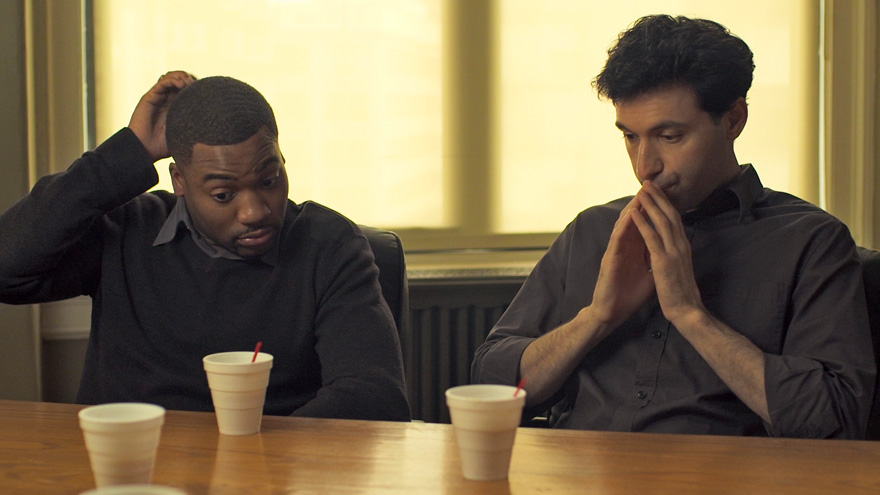
Daniel Schechter’s Supporting Characters, thankfully, falls into the latter category. It’s has its issues and spends the last thirty minutes trying to pay for its sins, but overall it’s an honest piece of work. The problems I have with it are ones that could only be corrected by Schechter making a different film. I’m glad he didn’t because what we have is a mostly enjoyable, if sloppy, piece of work.
The film follows Nick (Alex Karpovsky), a sought after editor of broken (read: shitty) films and Darryl (Tarik Lowe), Nick’s best friend and assistant editor. The two are trying to get a romantic comedy in the can while navigating the murky waters of their personal and professional relationships. Nick can’t help but let his eyes stray from his fiancé, Amy (Sophia Takal), when the film’s star Jamie (Arielle Kebbel) starts tossing pheromones his way. Darryl, meanwhile, is in a destructive relationship with Liana (Melonie Diaz), a dancer who can manipulate him at her whim.
Supporting Characters is about men and the women that get in their way. Sophia Takal, herself a talented filmmaker, is excellent as the adorable and supportive Amy. For my money she makes for a great Anna Kendrick stand-in and is someone who should be getting roles in more sophisticated work. Nick’s problem with Amy seems to be that she’s too supportive. She begrudges that he gets to sleep in and bumble about their spacious Upper West Side apartment, but that’s the extent of her criticisms. Nick isn’t just annoyed by her; he seems to loathe her and avoid her for reasons I can’t understand.
In almost every film he is in, Karpovsky plays a nudnik who is funny enough to get close to beautiful women and plain enough that the weak ones will sleep with him. Here he is a feeble and manipulative editor, but he is so good at convincing women that he is clever that he never sleeps alone. He makes for a very unsympathetic hero. His conflict is whether or not he should bang a movie star or stay engaged to a gorgeous and supportive woman, or do both and cover it up.
Darryl, on the other hand, is the weakling of the team. As Nick’s second fiddle, he is so unsure of himself that he would rather remain in a destructive relationship than be alone. Tarik Lowe, who also co-wrote the film with Schechter, does a great job of bringing this character to life. He’s not too complicated, but clearly he has an axe to grind with his lot in life. As good as Nick tries to be, he is ultimately a jerk; watching Darryl reconcile this fact with his own business is the more interesting storyline.
If you ask me whether or not I think Supporting Characters is a good film, I’ll tell you that I don’t think it is. I can’t get over how uninteresting the women are and how annoying Karpovsky’s character is. But it’s an honest piece of work made by a filmmaker who seems sure of himself. That is commendable, and I’m excited to see Daniel Schechter’s next project.
Shawn Blanc on Clicky Keyboards ⇒
Shawn Blanc just published the clicky keyboard blog post to end all clicky keyboard blog posts:
Mechanical keyboards like the Das are bulky, loud, and fantastic for typing. Compared to the slim Apple keyboards, the Das is different in every way except that the end result is still the same: words get onto the screen.
I’ve been interested in a Matias Tactile Pro 3 for years,1 but I’ve never had the guts to shell out for it. Shawn offers in-depth perspective on the three big Mac mechanical keyboards: the Tactile Pro, the Das Keyboard and the Apple Extended Keyboard II.2
I’m sure I will revisit and reread Shawn’s post many times before I finally break down and buy one of these keyboards. Frankly, if the Das wasn’t so needlessly ugly (unlike Shawn, I can’t get over the ridiculous typeface on the keys) I’d probably order one right now.
But I need to stop shopping and just write, right?
-
I use Apple’s current model aluminum keyboards if you must know. I have a USB with numeric keypad one at home and a bluetooth one I use with my iPad. ↩︎
-
He skipped the buckling spring SpaceSaver M. Too nerdy? ↩︎
Tribeca 2012 Review: Consuming Spirits
Consuming Spirits Still
I like to whine about how “Hollywood” the Tribeca Film Festival is, about how similar most of its Amer-indie slate feels.1 As many workshopped talkies as one may endure, this is still New York City, historically a hotbed of experimental cinema. There is no handbook for these adventurous filmmakers; no one telling them the gun must go off in the third act. It is this freedom that allows them to come up with some of the wildest films imaginable and execute them on a (sometimes literal) shoestring.
Chris Sullivan’s Consuming Spirits is listed as an experimental animation, but I think that’s a bit of an unfair description. While its technique of handmade 16mm animation certainly qualifies it as a trial in patience, it is, at its core, a narrative. The “experiment” is a mere playfulness with time, scale and reality; it may even be too tame to be considered all that experimental in some circles. I imagine it is listed as such because no one else in the fest wanted it, and that’s a shame.
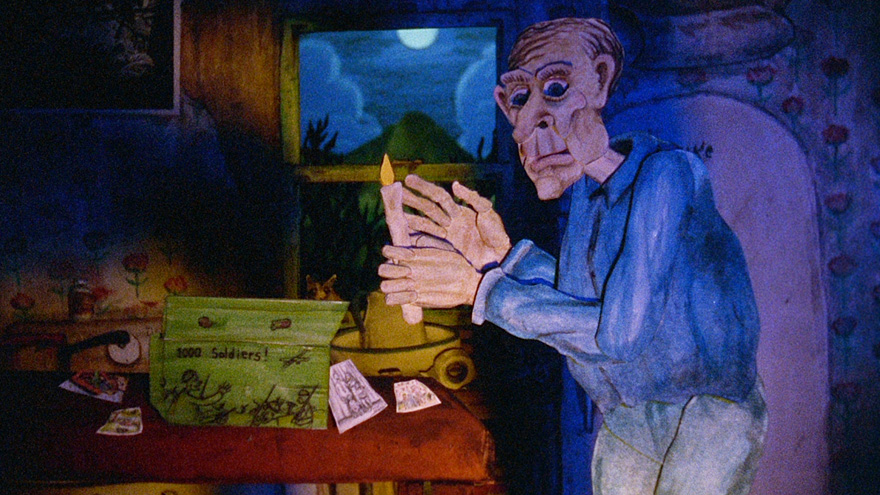
As a narrative Sullivan’s film is an invigorating experience, unencumbered by the silly rules we’ve imposed on the storytelling process. It is a 130 minute portrait of a small Appalachian town whose inhabitants are as gruesome as they are endearing. Sullivan employs stop-motion, paper-craft puppetry and hand-drawn animation to tell his tale, each form placing the audience in a different temporal and/or emotional realm.
The film tells the story of a small Appalachian town called Magguson. When Gentian (or Genny) Violet, a Jane-of-all-trades who drives a schoolbus, works at the local newspaper and gives tours at the museum, hits a transient nun on the road one night, she set off a chain reaction that ultimately unravel’s one family’s well-hidden dirty laundry. Part thriller, part family drama and part dreamscape, Consuming Spirits is like no other film I can recall.2
Sullivan isn’t without a sense of humor; in fact he’s downright puckish. The title itself is a pun and the film is peppered a few good laughs few geared directly at the cinephile set. Like the scene in which one character picks out a skin flick featuring mental patients putting on a lascivious show: “Titty Cut Follies.” Fake porno titles are a comedic past-time at this point, but the humor here is brilliant. By invoking Frederick Wiseman’s groundbreaking documentary, Titicut Follies, Sullivan gets more than a cheap laugh; he ties in the horrors of a sanatorium without having to show it to you. (Magguson has a sanatorium that plays a central role to the film’s plot.)
The animation itself is astounding. Sullivan’s characters are monstrous and beautiful. Their faces are creased and pocked with bags under their eyes, their teeth yellowed or blackened or barely there. These paper stand-ins are imbued with all the frailties and deformities of humans. Perhaps it is their closeness to how people actually look, warts and all, that makes them so tough to look at. They are more mirror than they are lens unlike, say, the airbrushed hardbodies we see at the multiplex.
The hand-drawn segments are less invigorating, but nonetheless wild to look at. As the narrative unfurls, the form comes into sharper focus, making it a bit clearer why different techniques are employed. It’s a deft move and one I appreciate more now that I have digested the film a bit.
Chris Sullivan spent almost fifteen years making Consuming Spirits and it’s a marvel to behold. All movies are hard to make, so he doesn’t get bonus points for taking his time. However, by not relenting when the technology changed, by seeing his vision through after all these years, Sullivan brought to life a unique piece of work that I am glad wasn’t rushed.
Finally, this project was funded in part by the John Simon Guggenheim Foundation, the Rockefeller Foundation and a recent Creative Capital grant. Money. Well. Spent. Consuming Spirits is a piece of work that is a hard sell for anyone. Champions of experimental film are few and far between compared to the billions investors pour into the blockbuster and indie markets.
This is not only a great piece of art, but it’s a great movie that I think could be seen by any kind of audience, even those who wouldn’t be caught dead watching an “experimental film.” I’d be remiss if I didn’t mention that those who support this kind of work deserve a pat on the back. We shouldn’t have to wait another fifteen years to see what else Chris Sullivan has to offer. Here’s hoping we won’t.
Text & Death
iOS Text Editors
I can’t be the only one who looks at Brett Terpstra’s prolific iOS text editors comparison chart and thinks of his own mortality, can I?
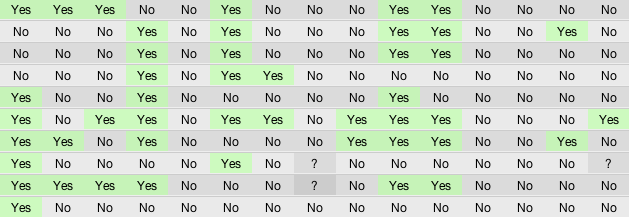
If you haven’t seen it yet, the chart in question is worth a peek even if you don’t care about iOS text editors. The methods Terpstra used to build the thing prove what a web wizard he really is. Most of the info was crowd-sourced into a Google spreadsheet and then built straight into the niftily designed chart. It’s an excercise in efficiency, a sort of data parkour.
What strikes me is the absurdity of the chart itself. It’s massive, covering not only every known text editor in the App Store but also every feature. And it gets pretty granular. “Reading Time,” the ability of an app to display the approximate time it will take to read the current document based on its length, gets its own row, for example.
I’m not here to mock Terpstra’s product. Not at all. It is an invaluable snapshot of what is available right now in an increasingly cluttered marketplace. As I’ve written before, I buy a lot of text editing apps. I use them all for different writing tasks or to cater to my different moods.
What freaks me out is how excited I was when Brett published his chart. Looking at it, all I can think is how ridiculous the whole plain text craze has become. I’m as guilty as anyone of obsessing over the tiny details in these apps, and I love that there is now a resource where I can quickly drill down the exact feature I need. Here’s the thing, though: the perfect text editor doesn’t exist.
I should know, I’ve bought (almost) all of them.
If I’ve learned anything from perusing Brett’s chart, it’s that I need to stop worrying about apps and just write more. It really grates on me when people spout motivational platitudes like that1 but I think it’s applicable here.
Life is short and the considerable time I spend wondering which app has the best Markdown implementation2 is time thoroughly wasted. Write more, shop less; all of this will end someday.
So thanks, Brett, for the perspective.
Rules to Break ⇒
Many claim that voiceover (and I am cheating a little bit here by using "voiceover" and "narration" as interchangeable, even though they're somewhat different things) is not very rigorous, and yet some of the most rigorous films ever made – Bresson’s Diary of a Country Priest and A Man Escaped, Alain Resnais’s Last Year at Marienbad – utilize it. We mouth to ourselves the idea that there’s something impure about narration, but when it pops up in the right situation we embrace it. Sometimes I wonder if we just create these rules so other people can break them.
I’m as guilty as anyone of rolling my eyes when I hear voiceover narration, and in many cases it’s because I ascribe to the exact “rules” Ebiri calls into question. Perhaps I am simply disappointed in how poorly this uniquely cinematic technique is often employed, not with the technique itself.
I’m glad Ebiri took the time to thoroughly discount the belief that voiceover is inherently flawed or a lazy crutch, offering some great, classic examples.
(via Matt Zoller Seitz.)