An Off-Schedule Redesign
Every year since I started the candler blog I make the foolhardy decision to redesign the site, almost like clockwork around New Years. This year I even went so far as to switch from Wordpress to Octopress. Well, I don’t know why but I recently felt the need to change things up around here a bit.
Maybe I felt that moving halfway across the country wasn’t enough of a change. Maybe I was jealous that Gabe over at Macdrifter was having all the static redesigning fun. I don’t know. But I do know that Monday’s post, “Practice Makes Better,” was the result of me trying to pump myself up to finally take on the challenge of moving things around here. For the longest time I figured that, if the site is working as-is, why mess with it? Because I can, because I want to and because, if and when I break it, I can always fix it.
So, welcome to the new candler blog. And if this is your first time joining, please take a look at what it looked like this morning:
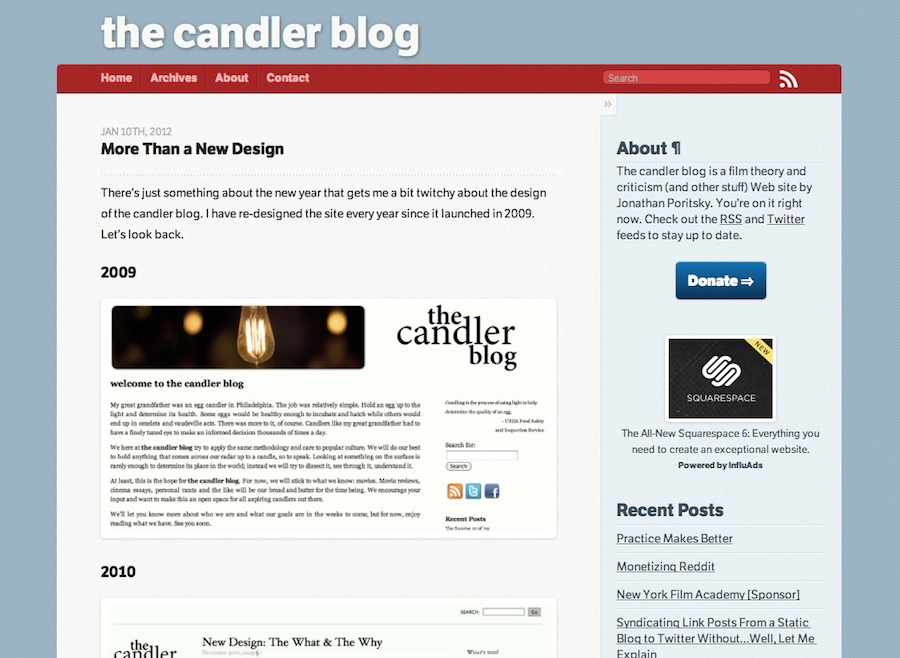
Old Candler Design
I know there are parts of the site that may look off for now. If you run into any problems or have suggestions, please don’t hesitate to let me know in the comments or in an email.
And please enjoy the site. Plenty more to come.
Kogonada Speaks (To Me) ⇒
The mysterious kogonada, who has been anonymously posting supercuts/video essays to Vimeo all year, most recently “Kubrick // One-Point Perspective,” was kind enough to talk with me for a piece over at The Creators Project:
How did you come upon this form?
I never really came upon it specifically. I think, like everyone, I’ve noticed that online videos have become increasingly more original and engaging. In the past, there’s never been a popular place for short pieces, outside of commercials and music videos. They existed in museums or film festivals, but now more than ever there’s an appetite and a place for shorts, whether they’re narratives, docs, essays, experimental pieces.
Read the whole thing. Kogonada has a unique perspective on cinema and the Internet, I could talk to him1 all day.
-
We conversed over email. I honestly have no idea if Kogonada is a man or a woman, but I can only go so long without using a pronoun. ↩︎
The First Apple Channel ⇒
Craig Hockenberry is one astute dude:
For the month of September, Apple is letting customers view live shows through a combination of apps, the web, and Apple TV. It’s the fourth year of the iTunes Festival in London, but this is the first year that it’s been broadcast via iTunes. […]
Could this be akin to HBO creating premium content for it’s subscribers? Or Netflix producing its own shows to make it’s streaming service more desirable?
Smart.
I don’t see a world where Apple cuts Netflix-sized checks for original content, but I do see one where filmmakers give Apple their content in exchange for access to the vast iTunes audience. Just look at the Podcasting community.
(via Dan Frommer.)
Monetizing Reddit ⇒
Good on David Carr at the New York Times for filing a piece on Reddit, which is still an enigma to most followers of old media. His inroad is President Obama’s historic AMA (“Ask Me Anything”) thread from last week. As someone who couldn’t believe a sitting president would go on Jon Stewart, I was blown away he would subject himself to the hive mind of Reddit,1 but I’m glad he did, if only to put the site on the radars of those who think it’s just for nerds.
Here’s my favorite bit:
Reddit is not an exception to every rule in the digital world. Like many digital media companies, it has a big audience and minuscule revenue. Bob Sauerberg, president of Condé Nast and a member of the board of the independent company, says that is fine by him.
“We think it has huge potential and we want to make sure that we scale that,” he said. “There will be ample opportunity to monetize what they have built as it grows, and it will be a very big business.”
Reddit’s users won’t allow it to be monetized in any traditional way (see: Digg), so as a company they’ll have to be spry and forward-thinking. Sauerberg’s untraditional sentiment seems predicated on two ideas:
- Don’t mess with a product that works.
- If you can’t find a way to make money with a community that large, get the hell out of Dodge.
This is very welcome thinking from an old media stalwart like Condé Nast. Let’s see where the site is two years down the line.
-
Hell, I can’t believe he exposed himself to the obvious criticism of his typos. ↩︎
Practice Makes Better
When I was growing up, my father was the drummer in a wedding and Bar Mitzvah band. At their peak the band played 60-70 gigs a year, mostly on weekends. That’s a lot of challah.
I used to go on gigs with him. I’d don my little tux and learn the ropes of the whole “I’m with the band” ethos: getting there early to see social halls and gymnasiums transformed into luxurious party rooms, scoring franks in a blanket1 and scarfing them out by a loading dock, watch grown adults act like children whining about the music being too loud, etc. My dad let me play all manor of small instruments, like the tambourine or maracas, anything that made a bit of noise but wouldn’t bring down the whole affair if I screwed up.
Once I got older, it was time to learn my own instrument. At first I tried the drums, but I quit after only a few lessons.2 Instead I chose what I (correctly) believed to be the coolest of all instruments: the saxophone. In fourth grade I started playing alto sax.3 Once I was able to make it through a freilach, I started bringing it with me to gigs.
Now, I was pretty good. I could read the music and feel the beat, plus these were Jewish standards I grew up with, so all it took was a phrase or two for me to get in the groove and start noodling. In our basement, playing along with a cassette tape, I could power through most of the band’s regular set. It was in public that I had trouble.
I guess you could say I had stage fright. The trouble with playing Bar Mitzvahs, as I explained to my father, was that I was worried I would ruin the party. If I missed a note I would probably just stop, but what if I started honking nonsense? Wouldn’t it cause some kind of aural damage to the guests and possibly spoil an otherwise joyous occasion?
My dad told me to calm down and listen to the keyboardist play a song. He was one of my dad’s childhood friends and part of the reason the band had survived three decades. In my eyes, he was everything a keyboardist should be and more. But I took a moment to listen closely to his performance and noticed something: he messed up, a lot. He’d miss notes or fat-finger some extra keys. His voice was decent but inconsistent and had a limited range; if ever he had to hold a note, he’d wobble in and out of tune. But if he made a mistake he’d just keep going and get back on track.
From then on, I got a little bolder with how many songs I would play at events, and I started playing louder. I even went so far as to start improvising, jazzing up the hora just a bit. When I made mistakes I kept going, and as a result I became a better musician.
Everything I do is a process. This site is a process. I will fail many times, but what’s important is what I do with those failures. On the sax, I learned to keep going into the next phrase and get better. If I stopped playing, then I stopped being a part of the band, and that was always the bigger failure.
-
Never pigs in a blanket at Jewish functions. ↩︎
-
I found paradiddles tiresome, but I do play the drums, only as well as someone who didn’t take lessons. ↩︎
-
I can still play, but in general I don’t, a fact I constantly regret. Perhaps I should break it out again and challenge David Sparks to a duel. ↩︎
New York Film Academy [Sponsor] ⇒
My thanks once again to the New York Film Academy for sponsoring this past week of the candler blog.
For the aspiring actor, getting a break in an acclaimed film may seem like the career breakthrough moment. But for many it comes before that: In the training, the exposure to new and established film acting talent, and acquiring key tools: students gain experience with film equipment, work on live film shoots and create their all-important actor’s reel.
The New York Film Academy, with campuses in New York, Boston (Harvard University campus), Los Angeles (Universal Studios) and Orlando (Disney Studios) – as well as locations abroad in Europe, Asia and Australia – offers those pre-stardom experiences that have launched the careers of many new stars of TV and film: Aubrey Plaza (“Parks & Recreation”), Camilla Ludington (“William & Kate”), Eve Hewson (“This Must Be the Place”), Chord Overstreet (“Glee”) and Analeigh Tipton (“Crazy Stupid Love”).
Additionally, NYFA campuses draw an exceptionally broad mix of students from all over the world. It becomes a reference point for global careers.
Syndicating Link Posts From a Static Blog to Twitter Without...Well, Let Me Explain
A few weeks ago I started syndicating all of the posts from the candler blog to a new Twitter account, @thecandlerblog. Since I’m off Wordpress and thus can’t use a fancy-pants plugin to achieve this, I decided to use an If This Then That (IFTTT) recipe to take my site’s RSS feed and send out a tweet on the new account. Easy!
Not so fast. I ran into a bit of a problem that I figured was edge case-y enough that I didn’t need to bother you all with the nerdy details of how I fixed it. But Doug Stephen just posted his own hack to solve the exact same issue, so I figure it’s time for me to share the sauce (really, it’s very boring sauce) on how I got it up and running.
The Problem
There are two kinds of posts on the candler blog: Normal, long-ish blog posts like the one you’re reading right now, and link posts,1 which are shorter and feature a headline that links out to a different site. I love writing link posts, and I encourage readers to go check out the sites I’m linking to. I’m only too happy to have readers subscribe to my RSS feed and experience the site through a feed reader.
However, this setup doesn’t quite work on Twitter. All I want posted to the site’s official feed is the post title and the URL back to the candler blog. Why? Because I believe the full experience of what I’m trying to do here comes from the headline I choose, the sites I link to and the commentary I write.
The IFTTT RSS to Twitter recipe can only syndicate the post’s title and the URL it points to. In the case of link posts, all you will see is a headline and a link to some other site. That would be all well and good except it basically diminishes the whole experience of reading the candler blog. There will be no context for the link. Or the headline. So that wouldn’t do.
The Fix
Enter Yahoo! Pipes. If you’ve never played with Pipes before, I highly recommend taking it for a spin. I barely know the full potential of the tool, but I do know this: it allows you to take any RSS feed, even multiple feeds, and rewire them to your liking. Want to mash some feeds together? What to get a new feed featuring only the work of a single author? How about only tagged with things you are interested in? It’ll do all of that and more. And it allows me to reconfigure my site’s feed to change the destination of link post URLs back to the candler blog. Here’s a quick look at what my pipe looks like:
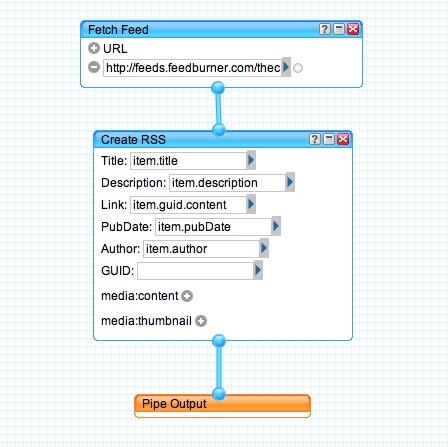
My Link Fixing Pipe
The first little window you see is simply there to fetch my site’s RSS feed. All that needs doing there is to plug in the Feedburner URL of my feed. Easy.
The next window is where all of the magic happens. The Create RSS module (under “Operators” in pipes) allows you to do the rerouting of feed level items. In short, it gives you a blank slate of an RSS feed, and then allows you to plug in whatever data from your feed you want. In my case, every part of the feed should remain the same except for the Link section. Items like title and description are all available from a drop down in the RSS creator module. All I needed to find was which operator to plug into the link level to tell pipes to use each post’s permalink as its title link.
Following?
Along the bottom of the pipes interface is a handy little tool that displays whatever your feed looks like on the selected module. To find the permalink in the feed, I selected the Fetch Feed module (the one at the top) and started digging through the feed output? Here’s what it looks like:
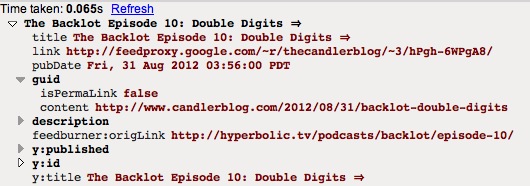
Pipe Output Display
The permalink pointing to my site is, luckily, easy enough to find under guid > content. Simply type item.guid.content into the Create RSS line for Link and connect it to the pipe output. Now, instead of the external link, the RSS headline will be point to the original candler blog post.
Save the pipe, then from the “My Pipes” page, grab the new RSS feed. Go back to IFTTT and create a recipe using the pipe RSS feed. Boom. A convoluted workaround to account for link posts.
Almost Done
All this automation is well and good, but sometimes I like to push it along. For that, I have a few handy bookmarks in a folder that I click after posting.
First off is pinging my feed. Feedburner is supposed to ping your site every 30 minutes, but, you know, Feedburner sucks. Luckily, they have a manual pinging page where you can enter your feed and ping away. The URL of the page that returns when you do this is actually all you need to set off a manual ping, so after you do it manually, just drag the page to your bookmarks bar and save it. The URL should look like this:
http://feedburner.google.com/fb/a/pingSubmit?bloglink=http%3A%2F%2Ffeeds.feedburner.com%2F[your-feed-name-here]
// Sans brackets, of course. //
Next, I like to check on my pipe and make sure it refreshed. To do that, I simply saved the direct URL to my pipe as a bookmark. After I ping Feedburner, I go and check that the pipe received the update. If it hasn’t, no worries, it picks it up quickly enough.
Finally, I keep a bookmark handy that points directly to the IFTTT page for the Twitter posting recipe. I tried saving IFTTT’s built in force-run URL scheme, but I have been unable to actuate it from the Bookmarks Bar. Visiting it simply takes me back to my recipe page. If I really want a tweet to go out right away, I go to the IFTTT page for the recipe and click “Check Now.” I’ve stopped doing this unless I plan to post more than one post in the space of 15 minutes, IFTTT’s automated (and quite reliable) refresh time.
Go Forth and Post
If I had to guess, I’d say it took me about 15 times as long to write this blog post as it did to set up this Pipe and IFTTT recipe. Both tools work incredibly well together. Pipes is powerful for taking any number of RSS feeds and turning them into the content that you want, and IFTTT allows you to do all kinds of wacky stuff with an RSS feed. And now that I’ve set it up I rarely think about it, so I’m glad I did.
This system works well for me on Octopress, but I assume that it works similarly for any static blogging system. Your mileage may vary, but I’d love to hear what blogging engines this works on and which ones it breaks. And if you have ideas on how to finesse this, please do share.
-
Or Linked List posts or Linklogs or Linkblogs, pick your poison. ↩︎
The Backlot Episode 10: Double Digits ⇒
Ryan and I confront my problem with analytics on the new episode of The Backlot. Go get it or subscribe in iTunes.
50 Years of Bond at MoMA ⇒
New Yorkers are getting a little Bond treat this month at the Museum of Modern Art:
Coinciding with Global James Bond Day on October 5, the exhibition kicks off that evening at 8:00 p.m. with the screening of Dr. No introducing Sean Connery as the original Bond, and will screen the Bond films in chronological order twice during the month of October.
October 5th is the exact 50th anniversary of Dr. No’s premiere.
Bonus, from the press release (PDF):
Accompanying 50 Years of James Bond is Goldfinger: the Design of an Iconic Film Title, an installation that features the first film title sequence to enter MoMA’s collection as a design work in its own right, in conjunction with related preparatory material.
The films, I assume, will screen here in Austin at some point, but I’m curious about that installation. Probably worth a peek if you’re in NYC this fall.
The Classics in 2050 ⇒
Over at The New York Times, Julie Lasky ponders which items will be considered classic icons of design in the future:
For a better perspective, I asked a dozen contemporary furniture experts for their opinions on which objects produced in the last decade or so would occupy the design-conscious home of 2050, just as, say, the Eames lounge chair, a mid-20th-century creation, resides in ours. […]
Half the designers, scholars and connoisseurs I polled, in fact, selected an Apple product as an example, if not their sole choice, of canonical early 21st-century design.
There seems to be some disagreement over whether the original iPod or iPhone is more iconic. Personally I’d vote for the 4th generation iPod.