Bigger Than Twitter
Yes, I too have thoughts about Twitter’s recent announcement. But first…
Recap (Skip Ahead If You’ve Heard This One Before)
On Thursday, Twitter pissed of what seems to be every single blog I read when Director of Consumer Product Michael Sippey published a detailed list of changes coming to the site’s API.
For some context, here’s the chart Twitter used to explain the changes.
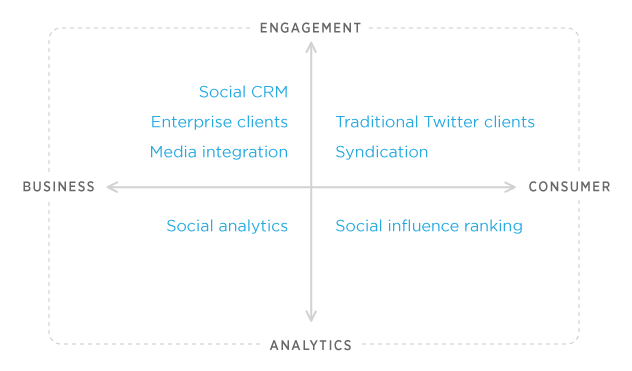
Twitter Dev Chart
And the offending passage:
That upper-right quadrant also includes, of course, “traditional” Twitter clients like Tweetbot and Echofon. Nearly eighteen months ago, we gave developers guidance that they should not build client apps that mimic or reproduce the mainstream Twitter consumer client experience." [sic] And to reiterate what I wrote in my last post, that guidance continues to apply today.
Translation: if you should maybe slip on some ice and fall off a bridge, don’t say we didn’t warn you.
Smart People Said Things
Folks who are much smarter than me had a lot to say about Sippey’s post.
So Klout, which is utter vainglorious masturbatory nonsense, that’s OK. But services like Storify and Favstar, which are actually useful and/or fun, those are no good. And don’t even get me started on Twitter turning against client apps. For chrissake Twitter’s own app started life as a third-party client.
What is sad is that as long-time and active users, we’re given no choice in the matter. We must suffer the official clients and we must suffer ads.
Twitter has stopped caring about the users that made the service popular, and started only to care about the users that can draw in more users.
I sure as hell wouldn’t build a business on Twitter, and I don’t think I’ll even build any nontrivial features on it anymore.
What to Make of All This?
I like to think of my time writing on the Internet in two separate eras: before I joined Twitter and after. There is no question that the service changed my exposure online. It has helped me reach a wider audience, gotten me in touch with some really smart people and helped me connect with folks who have turned out to be friends and sometime collaborators. So I care deeply about where Twitter is going and what it can (continue to) do for me.
But there are a few things that I need to try to remember:
- Twitter doesn’t care about me.
- Past is past.
- We (readers, writers, voyeurs, everyone) are bigger than Twitter.
We’ve all become dependent on what Twitter once was. Even adding “tweet,” both in its verb and noun forms, to the lexicon now seems like a foolhardy move. As much as we want it to be that thing we used to love, Twitter remains a private company that can do whatever the hell it wants. While so many are decrying the fact that Twitter is effectively screwing the users that made it what it is, I can’t help but think, “So what? Isn’t that what companies do?”
Twitter has a storied history of third-party innovation. Craig Hockenberry, maker of Twitterrific, which was an iPhone app even before there was an App Store, details all of the firsts his app contributed to the service. And just like Gruber pointed out, Twitter’s first native iPhone app started out as a third-party client. Tweetie, which the company bought to get into the app game, was a revolutionary take on what a Twitter client could do. However, today’s Twitter app bears almost no resemblance to Tweetie. Once upon a time it represented everything Twitter wanted to be, but that’s no longer true. We can’t change that. The idea that Twitter owes developers anything is a non-starter. It sucks, but they don’t.
Which brings the conversation back to us. We are all bigger than Twitter. I like to think that we are bigger than social media, period. The way I view my history of writing online is problematic. Maybe I have become too reliant on these things that I don’t own. But I own this site. The web, it seems, is where the conversation is happening. Twitter and Facebook and Reddit and everything in between are simply ways to navigate the massive amounts of content floating around in the ether.
Other services will come along1 and most of them will probably fail. Maybe Twitter was a once in a lifetime innovation; maybe nothing will come close to being as great as it once was.2 Either way, we’ll all still be here, online, writing and sharing and commenting away. At least, that’s the plan.
The Need for Punishing Critics ⇒
Dwight Garner for the New York Times Magazine:
The sad truth about the book world is that it doesn’t need more yes-saying novelists and certainly no more yes-saying critics. We are drowning in them. What we need more of, now that newspaper book sections are shrinking and vanishing like glaciers, are excellent and authoritative and punishing critics — perceptive enough to single out the voices that matter for legitimate praise, abusive enough to remind us that not everyone gets, or deserves, a gold star.
There seem to be a lot of similarities between the current state of book and film criticism, at least going by Garner’s “Riff.” This next bit, though, points to a stark difference:
The novelist Reynolds Price, who died last year, paused to note the sorry status of book sections in his 2009 memoir, “Ardent Spirits.” When he was starting out in the 1950s, he wrote, a first novel in America received about 90 individual reviews; now a decent first novel is lucky to get 20. Most of those will be amiable squirts of plot description topped, like a lemon slice on a Diet Coke, with the dread weasel-word “compelling.”
Today there is a seemingly endless stream of film criticism coming from all angles. I don’t know how large or influential the online book criticism world is, but the online film criticism one ever-growing. Of course, the description of reviews as plot-description plus sprinkled compliments makes up the bulk of those reviews. We all need to be more punishing. My favorite critics are.
Backlot Episode 9: Journaling ⇒
The Backlot is back. In this latest episode, Ryan and I discuss my move to Austin, the importance of backing up and some wild and crazy uses for journaling applications.
Seriously, Ryan came up with an excellent way to keep track of what movies you watch. How? Go give it a listen or subscribe in iTunes. We’ll be back with another helping next week.
Ikea Getting into the Hotel Business ⇒
The Daily Mail reporting on Ikea’s move into hotels:
The hugely successful furniture retailer is looking to open 100 low-cost hotels across Europe.
The aim is to create ‘budget design’ properties with a boutique feel at affordable prices - an area considered one of the fastest growing in the hotel industry.
I always wondered what it would be like to live inside on of the little rooms they build inside Ikea showrooms. For a reasonable fee it might be easy to arrange that soon.
iTypewriter Redefines Clicky Keyboard ⇒

The iTypeWriter
Industrial designer Austin Yang has cooked up a goofy little iPad accessory dubbed the iTypewriter. In his words:1
People could be able to recollect old experience and memory by familiar appearance and haptic feedback. Instead of stroking on the screen with no feedback, this product can reflect a strong haptic feedback.
Admirable. Terrible.
Still, I kinda want one. Maybe a bluetooth version. Here’s a video of it in action:
{::nomarkdown}
{:/nomarkdown}(via reddit.)
-
I’ll refrain from red penning this one. ↩︎
Spielberg Talks to Itzkoff ⇒
Yes, the lede on this one is that Raiders of the Lost Ark will open on IMAX screens for one week, but really this whole interview with Steven Spielberg is excellent. Dave Itzkoff at the New York Times extracted some excellent answers from the director. Here’s just one.
Q.: When you made “Raiders of the Lost Ark,” you were taking your inspiration from many filmmakers of decades past. Now that a few decades have elapsed since then, do you see yourself having a similar influence on directors today?
A.: I have a lot of contact with a lot of young filmmakers. I run a studio with Stacy Snider, and we meet so many first-time filmmakers, or filmmakers that haven’t even made their first film yet, so all these generations are constantly mixing together. It’s not like one generation replaces another. It’s one generation continuing to inspire another. I’m inspired by so many of the movies I’m looking at today that are made by first-time filmmakers. If I see any good movie, it makes whatever I’m doing currently a better movie. Just for its very existence, it will make my work better, if I’m inspired by somebody. I don’t look at this as a trickle-down effect. I look at this, sometimes, as how the creative community shares their art.
What a wonderful sentiment.
Netflix is Making it Easier to Keep Watching Netflix ⇒
Netflix announced a new feature called “post-play” on its official blog:
When you finish watching an episode of a TV show, we’ll minimize the credits and tee-up the next episode. If you do nothing, the next episode will start to play in 15 seconds. You can also stop it to get more information or select another episode.
When you finish watching a movie, we’ll minimize the credits and offer you three recommendations to try next. If those don’t suit you, you can always go directly to search from post-play or go back to browsing to find something else.
Available now in a web browser and on PS3, coming soon to other platforms.
Sounds like a great feature. I hope soon they’ll allow you to build and share playlists. Imagine finishing a film and having suggestions laid out by a friend of yours (or a critic you like) instead of selected by an algorithm. Could be cool.
The name is stupid, though. “Keep watching” might make more sense. Or “Sedentary Sunday.”
Untimely Tip: Turn Your Mac into a Wi-Fi Base Station
Every once in awhile I remember this or that tech capability, the kind of thing that probably isn’t enough to make a whole blog post about and might make you go, “Yeah, dweeb, everyone knows that.” Or, maybe it’s something you never knew about and will be forever grateful to the guy or gal who opened your eyes to it. Anyway, let me get on with this first “Untimely Tip,” a collection of minutiae that seems useful to me and might be to you.
The Narrative
I just moved to Austin from New York City. We1 sent almost everything we own with a long distance moving company. Naturally, our furniture, clothes and techy things are all still en route while we’ve been here for a week. Which means we’re camping in the apartment in the meantime.
Because they contain my livelihood, I didn’t feel comfortable sending my iMac and my hard drives with the movers.2 Instead I packed it in the car, and I’m more than glad I did. During the days (days!) we spent waiting for Time Warner to come install Internet service, my trusty 21.5" iMac served as a DVD/TV All-in-One. I plugged it in, headed out to Vulcan Video and rented a handful of Breaking Bad discs. Perfect.
Between the two of us we have six Wi-Fi capable devices: two iPads,3 two iPhones,4 my iMac and her HP laptop. Earlier this year, I bought an Airport Express based on Ben Brooks’s suggestion and I couldn’t be happier with it. That tiny white hockey puck fixed all of my networking issues. Naturally, lacking foresight, I packed the little sucker onto the truck that is currently meandering around the country somewhere.
Crap.
Eager to get online, I was a bit annoyed to find that I’d only be able to hardwire the our cable modem into my iMac and not use it on our iPads and iPhones. Being that, until I bought a desk last night, the only furniture we had in the place was an air mattress and a lawn chair, the Internet would only be useful on our iPads. Plus, 3G service is spotty in the new place, so our phones could’ve used a little Wi-Fi juice as well.
And that’s when I remembered: I can just turn my iMac into a Wi-Fi base station. I did it once years ago on a music video shoot. Before we left New York, I upgraded to Mountain Lion, and I wasn’t positive that this nice little feature made the cut into the latest version of the OS, but lucky for me it did.
The Tip
Okay, here’s how to do it.
First, get your iMac connected to the Internet over ethernet. Once that’s working all you have to do is open up System Preferences and go to the “Sharing” pane. Down the left-hand side, select (but don’t check) “Internet Sharing.” Here’s what you should see:
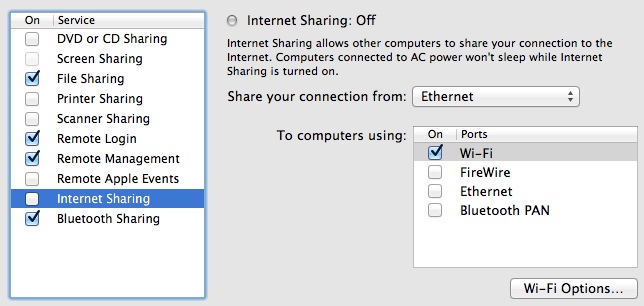
Internet Sharing Pane
“Share your connection from:” should be set to ethernet and “To computers using:” should only have “Wi-Fi” checked off. Click the button on the lower right that says “Wi-Fi Options.” The following pane will slide down:
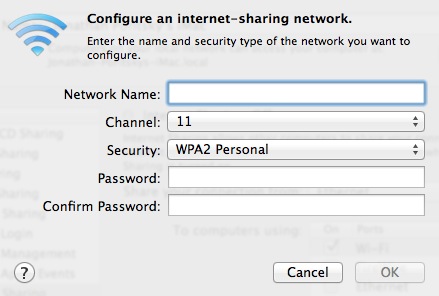
Wi-Fi Options Pane
From there, just give your network a name and a password. “Security” might not automatically be set to “WPA2 Personal,” but you should be able to select it from the drop-down menu. Hit OK then check the “On” checkbox next to Internet Sharing (see the last screenshot). If you have your Wi-Fi status icon visible in the menubar, it should now look like this:

Internet Sharing Pane
Ta da. Now you can connect your iPads and laptops to the network you just created and surf the web. Any Mac with an Ethernet port can do this little trick.
This has been useful for me twice in the ten years I’ve been using Macs. But hey, in both cases it came in incredibly handy, so I’m glad Apple keeps building it into OS X.
-
That’s me, the girlfriend (or Kristyn) and Krull, our Mini Dachshund. ↩︎
-
Though I did send one clone of my startup disc with them. Backup of a backup. ↩︎
-
I’ve got a 2, she’s got original recipe. ↩︎
-
We both have an iPhone 4, which I can’t figure out how to write in plural without confusing it with the iPhone 4S. ↩︎
Ai Weiwei Talks Cities and Twitter ⇒
Jonathan Landreth at Foreign Policy interviewed Chinese artist and dissident Ai Weiwei. I like this bit about New York:
In Little Italy, you can still see the old buildings and the streets where they shot The Godfather and Mean Streets. That’s a town where you can still relate to other people, your father’s or your grandfather’s joy or sadness. You can sense it. Normally we call it humanity. Where is the humanity in Beijing? Who can remember the corner where he went to school, or can touch a particular old piece of wall? Can you remember anything here? There’s nothing left.
What he calls humanity many would call nostalgia. This seems to be such an excellent case for sentimentality. Perhaps it’s what makes us human.
He goes on to talk about Twitter:
Twitter is my city, my favorite city. I can talk to anybody I want to. And anybody who wants to talk to me will get my response. They know me better than their relatives or my relatives. There’s so much imagination there; a lot of times it’s just like poetry. You just read one sentence, and you sense this kind of breeze or a kind of look. It’s amazing.
I don’t know how many times I’ve tried to explain to family and friends that Twitter is a place where I like to spend time. They look at me like I have three heads and then go check their Facebook statuses, the irony lost on them.
Ai, who owes much of his international prominence to the social network, put it better than anyone: Twitter is a city.
Happy Tenth, Daring Fireball
As others have pointed out, today marks the tenth anniversary of John Gruber’s Daring Fireball. Happy Birthday DF, and congratulations to John. Helluva milestone.
I gained a lot of readers here for my coverage of John’s schism with 5by5, but I hope those of you who have been around since don’t have the impression that I have any ill will toward Gruber. Daring Fireball remains a source of inspiration to me as a writer, a reader and a publisher.
Back in January, when I redesigned and refocused the candler blog, I quoted John as a means of explaining what I’d like this site to be:
I’m never trying to paint a picture of this week in tech, I’m trying to paint the big picture; like a years long tapestry. I have to do it, though, one day at a time based on what’s going on right now.
Maybe parts of the narrative change. Maybe, I’m wrong. You have to look at the story that’s being told over the course of a year.
I read Daring Fireball every day. This is perhaps the best distillation of what it is that makes Gruber’s site so honest, enjoyable and engaging. The idea of painting a big picture, a “years long tapestry,” is actually why I keep reading most of the sites that I love.
I still read it every single day. Like many other writers, too numerous to count, I owe a lot to John for pioneering this form and style of writing.1 I would never have even considered running a site with link posts if it weren’t for Daring Fireball.
Can’t wait to see what the next decade holds for DF.
-
Yes, pioneered. I really don’t care if linkblogging existed before DF, the guy’s a damn frontiersman as far as I’m concerned. ↩︎